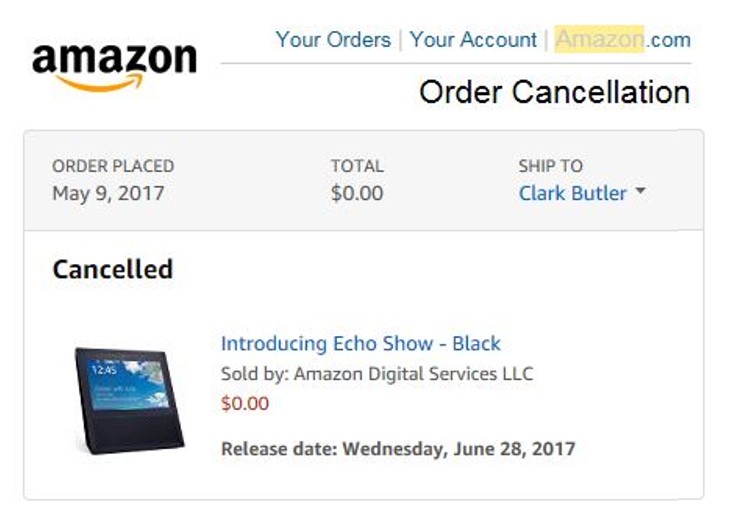
I’ve posted previously about the need for Smart Home Assistants to evolve beyond smart speakers, and include screens, or options for adding screens, to make them truly useful. So I was super very excited on May 9th when Amazon announced the Echo Show which included a screen, and I pre-ordered one that day.
However, as more details became available I began to realize that the Show, at least for now, isn’t going to deliver what I want a screen based smart home assistant for. That realization, along with the new features Google introduced last week for Google Home, showed me Amazon’s not quite there yet, and prompted me to cancel my pre-order for the Echo Show.
What are the issues? Let’s take a look:
- Echo Show’s Screen Features are Optimized Around Entertainment and Communications:
I know features will change over time, but for now, the Show’s incremental benefits over the Echo are optimized around displaying a limited set of information, playing music, and videos, and video calls, on a very small screen.
What I am looking for is a smart assistant driven screen to do thing like display the family calendar, show recipes, or even visually browse music sources and collections.
2. The Screen is Too Small:
I want to do the things above, but I want a larger screen. Especially in a scenario where the device is in the kitchen, the hub of most homes, I want to be able to see the screen from more than just a foot or two away.
And Alexa on the Echo Fire falls short. Not only does she currently lack the features I really want, the Fire tablets lack the microphone and speaker array approach of the Echo, limiting their capabilities.
3. Echo Show’s Communications are a Walled Garden:
Today, Alexa, and the Show’s, communications abilities, are only between Alexa Show devices or phones with the Alexa app, and that’s way too limiting.
The concept of our smart assistants extending into all parts of our digital lives, including voice and video communications, is extremely useful, but we need to be able to reach any person we need to, in the way we normally reach them; phone, text or email. Requiring a specific device, or app, on both ends is a huge limitation.
4. Echo Show is Not Particularly Attractive:
This one surprised me. I think the original Echo is an attractive design, and the Dot took that design and shrunk it down. They’re rounded, they’re pleasant, the Show is not.
The Show is angular, sharp edged, stark looking. Even the Fire tablets have a rounded aesthetic to them, but not the Show. It doesn’t look like it fits in the family.
And the speaker size to screen size ratio is way off. I’m sure the sound of the Show is impressive, but the already small screen looks out of scale in relation to the speaker grill.
I expect Amazon will introduce Show’s with different screen sizes; one similar to the current size which would be more appropriate on a night stand, and an 8″ or 10″ option more appropriate for the Kitchen.
They could even name them the Big Show and the Little Show ;-).
5. Google Home Showed Some Compelling New Features:
Till now, the capabilities in Amazon Echo and Google Home have been relatively similar, but Google has introduced several key features that, to me, are real differentiators including:
Voice Recognition for Multiple Accounts: Google Home will recognize the different voices of the people in you home so when you say “What is my next appointment?” it will read from your calendar, but when your partner asks “When is my next appointment?” Google home will read from theirs.
Hands Free Calling: Google Home will allow you to make calls by voice command like “Call my Mom” and will call any mobile or landline number (in the US and Canada to start), for free, and it will dial out with your personal number so people you are calling know it is you.
Visual Responses: Which is the ability to have Google Home display results on nearby screens including phones, tablets and televisions. What was announced was fairly rudimentary, and fairly limited, but the concept of casting results to an screen device is pretty interesting.
I love our Echo and Echo Dot’s; Alexa’s skills and capabilities are extremely useful, they have changed how we do many things in our home, and they’ve given us a taste, and an addiction, for what the world will be like with ubiquitous smart assistants.
And, while it’s a small thing, interacting with “Alexa” feels so much more comfortable than with the corporate-esque “Ok Google”. Plus, to the extent you can trust a large corporation to protect your privacy, I tend to trust Amazon more than Google, and even more than Apple and Microsoft.
That level of trust comes from knowing Amazon makes their profit off of goods and services I buy from them and, while they might be tempted to find new revenue streams in selling my data, they won’t compromise the retailer-to-consumer trust and goodwill that has been the foundation of their success.
I’m optimistic Amazon will continue to evolve their device form factors, and will be implementing features like those recently introduced by Google, but for me, the Echo Show isn’t their yet.
I strongly feel the key to long term success in Smart Digital Assistants will be a combination of dedicated appliances, like the current crop of smart speakers and devices like the Show, apps that extend across the leading platforms of iOS and Android, integrating with the services people already use, and making use of the existing screens and devices people already own.

 clarkb...