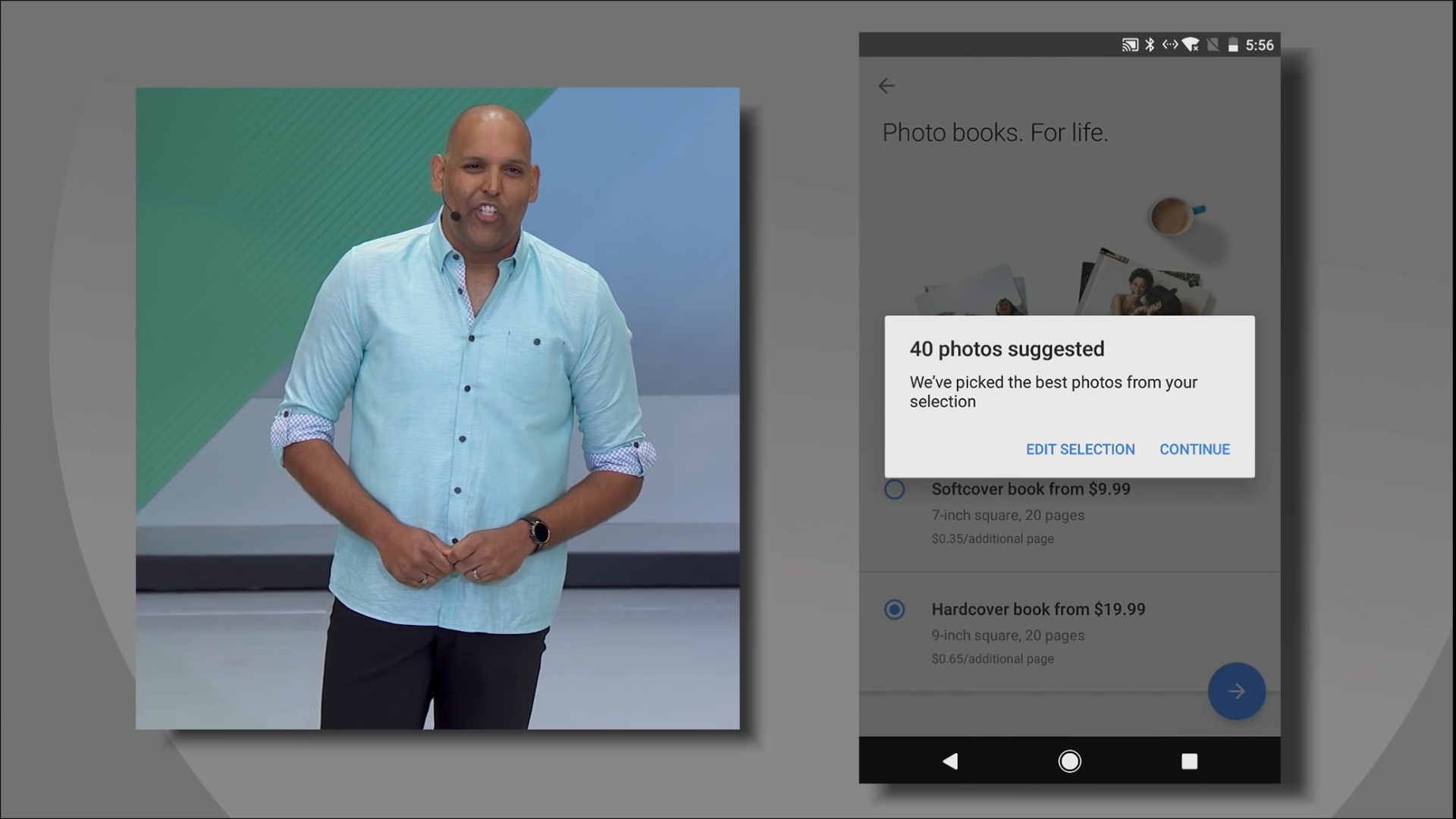
Last week at it’s IO conference, Google introduced a slew of impressive new features including enhancements to Google Assistant, Google Home, and Google Photos including the ability to more easily and intelligently share photos, and the ability to print Google Photo Books. It’s this last one, their approach to printed photo books, which I feel totally misses the mark on why you would want to go through the bother, expense and storage hassle of physical photo books: value and context.
Let’s look at each;
Value:
In this section of the keynote where he demos the Photo Books service, Anil Sabharwal says “I’ll select a bunch of photos here, and the good news is, I don’t have to figure out which are the right photos, which are the good ones”. Google’s Photo AI then parses through the photos and picks out what it considers are the “best” photos to create the book, and this is where they are missing the mark.
“Best” to Google’s AI are the clearest, sharpest images in the collection and while that is semi helpful, what you really want to print are the “most valuable”. The most valuable photos are those pictures that capture the important, meaningful moments.
Yes, some of those might be of a sunset, or the view of a landmark, but even for those, the clearest, sharpest one may not be the most valuable. Took an amazingly clear, crisp picture of the Eifel Tower, awesome, took a kind of fuzzy one with your partner standing in front of it? Now that ones valuable.
And you can’t just assume because your partner is in a picture it’s automatically valuable. It’s definitely a candidate for a valuable photo, but it’s not a guarantee.
The reality of photos is that any given picture might be a crappy image, but it might be a great moment.
And while Google’s advances in photo AI are interesting, they don’t yet replace the human knowledge of which photos are valuable. Might AI be able to do this eventually? maybe, but it’s going to have to get much more insightful into context.
Context:
Context is important because it both helps establish value as well as captures the memory, the story, of why the picture was taken and, more importantly, why it was chosen to be preserved in a printed book.
For simple books like “Our Trip to New York” or “Susan’s Graduation” the overall context is given, but specific context like “Mary standing in front of her Grandparents brownstone walk-up” or “Susan with her college roommate, Gwen” are totally lost.
And it gets even more complex when you attempt to put a highlight book together of the key events in a given year. Here there are dozens of contextual groupings; weddings, trips, visits from family, holidays, etc, which adds an additional layer of context required.
And the limit of Google’s AI here is to add person, place or thing context, but it has no ability to capture the context of a given photo.
I’ve written about this before but, to me, in the digital era, photos are worthy of being printed if they tell a story. They are worthy of being printed if they are valuable enough to be shared and even handed down, and that means the story being told by those photos needs to be captured.
I’ve had conversations with multiple friends and family members over the dilemma of what to do with the albums and boxes of photos when Parents, or Grandparents pass away.
These are important people, these photos contain important memories, yet we’re left at a loss because historically, the context and story of the photos disappear when the last one that remembers is no longer here.
To me, the solution is to combine the power of AI in helping to choose images of good quality, simplify the ability for me to specify photos of value, and provide a way to easily capture and transcribe the context and the story behind the photos.
In essence, AI working with natural human input, like speaking, to create Photo Books that warrant the bother, expense and storage hassle of physical printed books.

 clarkb...