I previously wrote about how Beats (Apple Music) and Tidal were making me rethink my approach to music listening, but since their introductions the reception to them has been pretty “meh”, and they haven’t had the impact on the industry I thought they might.
What is winning? For me, it’s convenience over content.
I originally thought the “exclusivity” these services touted would fundamentally change the music landscape and that the old adage “content is king” would prevail, but they didn’t.
Thankfully, artists have been exerting their influence over streaming services (thank you Taylor Swift). And even artist owned/backed Tidal (Jay Z and others) never came close to monopolizing music distribution the way they proclaimed as evidenced by Beyoncé (reminder, Jay Z’s wife) releasing her album Lemonade on rival service Apple Music only 24hrs after the “exclusive” release on Tidal.
It turns out the mass consumer audience doesn’t give a rip about who owns what catalog, or that catalogs are even owned or wrestled over within the industry. And I believe artists recognize that if they artificially limit where there music is available consumers aren’t going to switch to a new service, they just aren’t going to listen to their music.
So if the whole “we’re going to monopolize music” model doesn’t work, what IS going to work? Simplicity and convenience, as always.
Convenience Matters:
I’ll simply say, using the Amazon Echo for controlling music playback has been an epiphany, and is an early example of the power virtual assistants (geek speak: AI or “artificial intelligence”) will have on our lives.
The ability to say “play Bruce Springsteen” or “play NPR radio” or “play Coffee House Radio on Pandora” and have Alexa play it instantly is one of those make-you-smile things.
As amazing as that experience is, today that music only comes out of our Amazon Echo which is located in our kitchen. The Echo itself is a pretty impressive stand-alone speaker, but it doesn’t have audio-out capabilities and can’t be connected into our home stereo system for playing throughout the house.
Enter the Echo Dot:
The Amazon Echo was introduced in June of 2015 and Amazon introduced a smaller version, the Echo Dot, this past March, which did add audio-out capabilities. The March release was for a limited run of Echo Dots, which sold out quickly, and a new, updated Dot, was announced in September with a low, impulse buy price of $49.99, which became available to consumer today.
We Stream Almost All of Our Music:
Over the past few years the vast majority of our music listening has shifted to streaming services including Amazon Prime, Pandora, iHeart Radio, TuneIn Radio and Microsoft’s Groove Music. With the exception of Groove Music, we can stream all of the others via the Amazon Echo and with Amazon’s newly announced Music Unlimited, I may very well replace my Groove Music subscription with that.
That being said, control of the music is currently done via a connected PC or mobile device which requires you to be at the device, launch an app or web site, navigate to what you want, then click play, etc. In the big picture, and considering the vast selection of music at your fingertips, not that big a deal, but I tend to get relegated to the “hey Clark, let’s listen to …” music assistant, a role I am more than happy to turn over to Alexa.
Connecting to Our Home Stereo System:
We have in-wall speakers located throughout our house and also on the back patio, with everything hubbed into a central stereo “closet”. So want a device that is not just a stand alone speaker, but can be an audio source into the home stereo, which the Echo Dot can do.
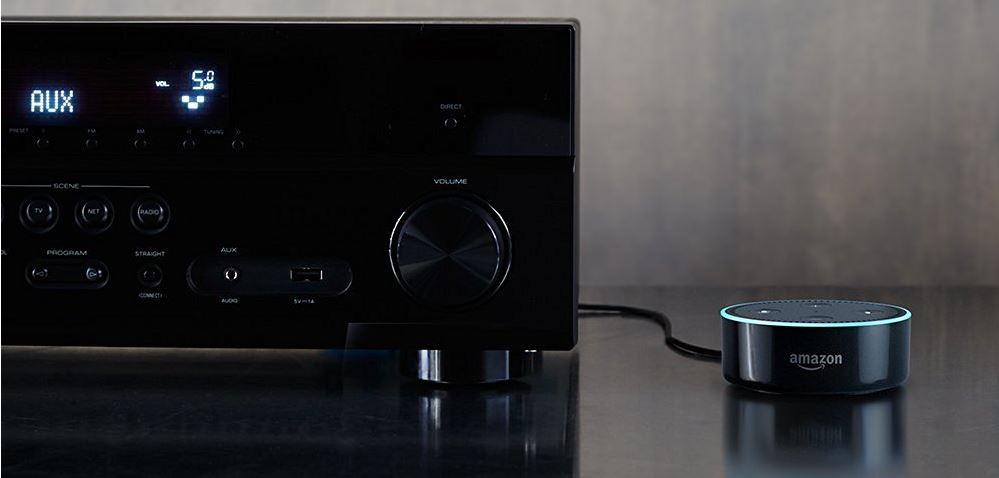
For now, I’ve added an Echo Dot next to the stereo receiver, in our case a Denon AVR, and connect it via the mini plug/headphone output on the Dot. This does mean that you do have to be near the stereo “hub” to give voice commands but that will soon change thanks to the good folks at Sonos.
A Bit About Sonos:
For those of you not familiar with it, Sonos is a home audio system that can start small and grow as you want to expand into a multiroom audio system.
Sonos makes several components including wireless speakers, amplifiers to power and transmit to those speakers, and a streaming media device, the Sonos Connect, with over 50 different music services built-in including Pandora, Spotify, Amazon, Apple, Google, Microsoft, etc, etc.
And the best part? Earlier this year Sonos announced a partnership with Amazon where they will be integrating the Amazon Echo and Echo Dot with their products so you can control your Sonos system from an Echo device. Very cool, and very smart of Sonos to not try to build voice control on their own.
When this integration is released in early 2017 we should then be able to voice control our music from any room in the house that has an Echo device, or from the Sonos app on our phones or tablets.
Needless to say, a Sonos Connect is on my Christmas list for this year.
So For Us, Convenience Wins:
As I noted above, depending on how Sonos integrates with the Echo, and if it is able to control all our music sources, including Groove Music, I’ll be sticking with Groove. Otherwise, I’ll be switching to Amazon’s Music Unlimited.

 clarkb...
I’m still not thrilled by the idea of putting an Internet connected microphone array into my home. But I’m a on the paranoid end of the spectrum with my tinfoil hat. I wasn’t all that interested in this post until you got to the Sonos part. I love my Sonos but it’s software is clumsy IMHO. Voice controlling my audio sources (streaming, and my own lossless collection) via Sonos would be very cool.
Agree, but the benefits are worth the risk, at least IMO for Amazon. Google? that’s a whole different story ;-)!