
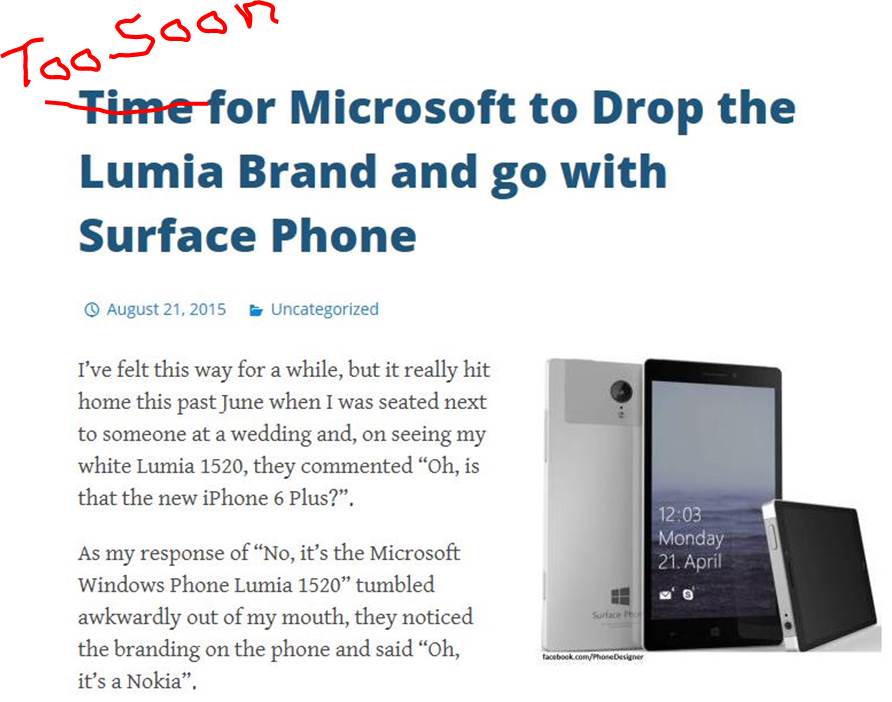
 In my most recent post I had said Microsoft should drop the Lumia brand and go with Surface Phone as the brand for their phone devices. They should, but I was wrong about when.
Watching the Windows 10 Devices announcement I was not only blown away by the innovations Microsoft is driving in both hardware and operating systems, I was also struck by the recognition of the investment they are making in developing a truly beautiful family of Surface products that deliver on a consistent design and brand promise.
So, as Panos Panay, VP of Surface Computing, walked through the way the new Surface Book is precisely milled from a billet of magnesium alloy, and described the devices exact fit and finish, it was obvious the new Lumia phones introduced earlier in the presentation were not designed, developed and engineered by this same Surface team.
Clearly, the new Lumia 950 and 950 XL were designed by the Lumia design team Microsoft inherited with the acquisition of Nokia. To their credit, this is an impressive team of designers but as beautiful as these new Lumias are, their origin is Lumia, not Surface, and while slapping the Surface brand on them might have been tempting, it would have been wrong.
And to me this is exciting on two dimensions; first is the fact that the new Microsoft has well aligned design efforts across the Surface family, and second, this means they are working on true Surface phones.
But if they’re working on Surface phones, and they are so far behind in the phone market, why didn’t they introduce them this year? It’s simple, their A-team had their hands full with the Surface Book.
To understand this, you have to recognize that in any company, or a major product division, no matter how smart and creative the people are, at the end of the day you have a single A-team. This team is the alpha amongst all others that has the vision, the acumen, and the design aesthetics to create iconic products. This A-team is the best and brightest in any given company. And at the head of this are the one or two people that drive that alpha team forward in a singular vision of what, for that particular company, the iconic products will be.
Apple clearly are leaders in this, but I’ve long felt that this has been an easier task for them as compared to Microsoft. Put simply, Apple has a much more narrow range of products they deliver. At it’s core, Apple is a consumer products company. Yes, their products are used in business, but this is a distant second in focus to the consumer products Apple makes, and they have built a huge and profitable business on this.
Microsoft on the other hand has a much broader range of products; from consumer, to gaming, to productivity, to enterprise software and cloud services, Microsoft produces a wide array of products. They too have built a huge and profitable business, but by definition, it has fragmented their development efforts and, in fact, previous management regimes had encouraged an almost Darwinian environment where competing groups worked on similar or overlapping products, and let the “best” product rise to the top.
While an argument can be made for this type of competitive environment, it’s clear that under Satya Nadella there is much higher alignment and coordination across the companies efforts.
To Apples credit, they have been able to focus their A-team on a much narrower, ever evolving set of consumer driven products beginning with the iPod. At a time when MP3 devices were proliferating Apple recognized that while music was a universal consumer market, the current MP3 players available at the time were niche, tech oriented devices. Apple assembled their best and brightest designers and engineers to create what became the iconic music device, the iPod.
Once this device established it’s lead in the music category, Apple shifted it’s A-team to focus on the next opportunity: smartphones. And as before, this A-team delivered an iconic product for the category, the iPhone, while leaving future versions of the iPod to be driven by the B-team to iterate on an established model, and fed design innovations from the iPhone back into the iPod.
Building on this success, the A-team then shifted to focusing on redefining the tablet category with the iPad, again leaving the B-team to iterate on evolving the already established iPhone.
And it’s clear Microsoft has this same A-team approach to it’s Surface family of products. And it’s also clear that slapping the Surface brand on phones with the Lumia design would have been wrong.
While I was fully intending to purchase one of the new Lumia 950’s I’ve put that purchase on hold. I have a beautiful Lumia 1520 which I will soon upgrade to Windows 10 Mobile and with the obvious release of a Surface Phone coming sometime next year I’ll save my money for that investment.
Now let’s just hope it comes with a Surface Pen ;-).

 clarkb...
1 Comment