
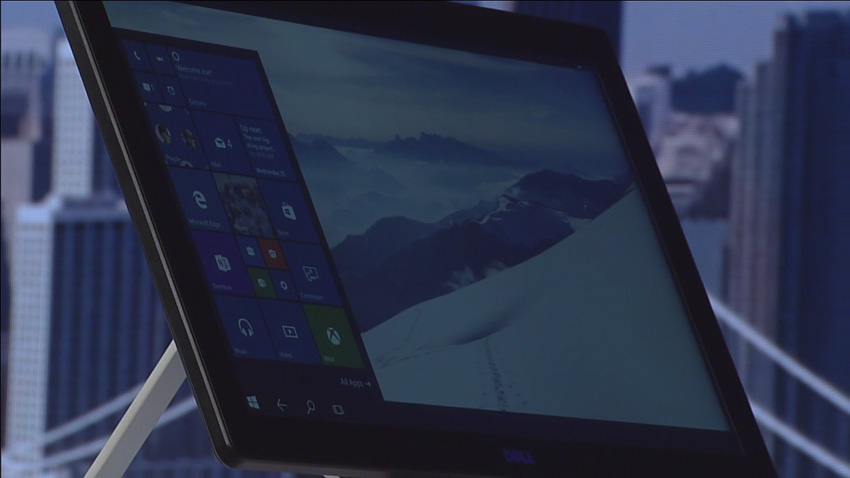
 Microsoft demonstrated a number of new things yesterday at their annual Developers Conference that have the potential to significantly increase their chances in mobile… and there was one thing they didn’t show.
Let’s take a look at what they showed, didn’t show, and what it means…
Showed Windows 10 Adapting to Different Types and Sizes of Devices:
In my post on 4/29 I talked about Microsoft’s intentions to have one operating system, Windows 10, that can work well across PCs, Tablets and Phones and one of the keys to this being the ability of the operating system to adapt to the different device types, screen sizes, touch vs keyboard/mouse, etc. Microsoft calls this “Continuum” and they demonstrated this yesterday.
The scenario they showed was a phone, running Windows 10, being connected to a larger monitor/tv, along with a wireless mouse and keyboard. The phone shows up in the lower left corner of the screen, and in essence you can think of it kind of it kind of like the start menu and it can be minimized or maximized, just like the Start menu in Windows 7.
You can use a mouse to tap one of the tiles/icons on the “phone”, aka Start Menu, it minimizes, and the app, like say PowerPoint, launches and Windows 10 recognizes there is a larger screen and adapts to that by basically displaying the full-screen version of PowerPoint, just like it would be on a PC as shown in the picture below.
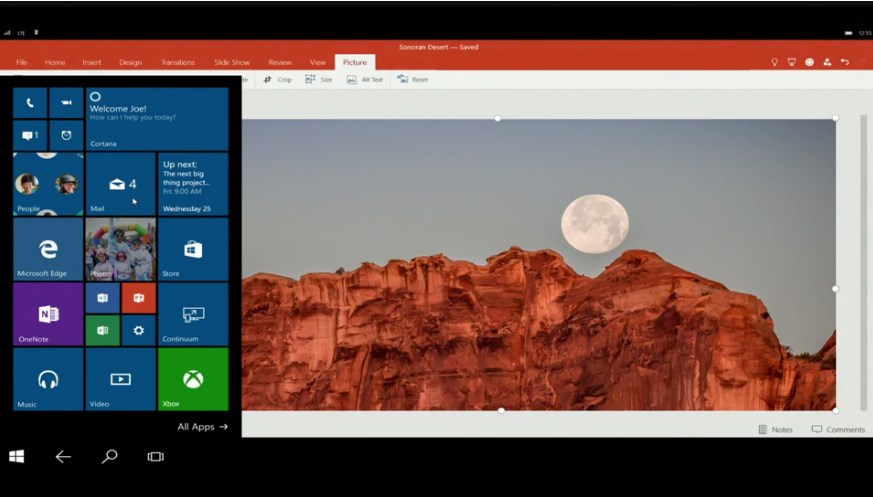
While people may, or may not, connect their phones to larger screens to use as a full PC, what this did demonstrate is Microsoft is doing a pretty impressive job of delivering an operating system that can span a broad range of devices and do a good job of morphing to fit the type and size of device being used.
Showed “Universal Apps” Running Across Phone, Tablet and PC:
One of Microsoft’s bets I talked about yesterday was providing an environment where the same app could run across a range of devices, and Microsoft demonstrated this yesterday. Now, there is still some minor additional work required for developers, but once these Universal Apps are written you can have the full power of a PC type app, scaled down to work on the smaller screen and touch input of a phone, or a phone app scaled up to take advantage of a larger screen and keyboard/mouse.
So that PowerPoint app running on the phone above? It’s essentially the same app, with all of the full power of the desktop version, that can adapt to whatever screen size or input method is needed.
Showed that Apps from the Android Play Store Can Be Installed on Windows 10 Mobile Phones and Tablets:
My post from yesterday referenced rumors of this and Microsoft announced and demonstrated this at their developers conference yesterday. Essentially Microsoft has built support for Android apps into Windows 10 that lets them run un-modified, in most cases. For the most part this means developers can take their Android apps and make them available in the Windows app store as soon as they make them available on Android.
We’ll still need to wait and see the real-world effort that it takes, and the resulting performance of the Apps on Windows, but this is a pretty amazing way to make the 1.3 million Android apps available to Windows customers.
Showed that Apps from Apples App Store Can be Re-generated to Run on Windows 10 Mobile Phones and Tablets:
The iPhone/iPad apps don’t work on Windows 10 quite as automatically as the Android apps do, but Microsoft introduced tools that allow Apple developer to tweak their code a bit then generate a version of the app that will run on Windows 10. In fact, some large developers have already done this using an early version of the tool for Windows 8.1 and this is how Candy Crush from King’s was quickly and easily brought over from the iPhone and iPad to Windows 8 today, and this will be even easier to do with Windows 10.
Again, we’ll still wait and see the real-world effort, and iPhone/iPad app developers will still have to see the extra value in making the effort to do this, but their jobs just got much, much easier in doing this and the potential exists for the 650,000 App Store apps to be made available on Windows 10.
The One Thing They Didn’t Show, New Phones and Tablets:
Of course, the biggest thing that drives consumer interest and excitement is the actual phones and tablets themselves, and Microsoft did not show off any new hardware yesterday. They did allude to new devices, with new capabilities like allowing phones to display one set of things, say like a Netflix movie, on a large screen, while the phone screen itself showed something else, like email or a browser, allowing the phone to effectively do two things at once, but I don’t expect we’ll see new phones and tablets until later this year.
Of personal interest to me will be the possibility of a “Surface Mini”, which was rumored last year but apparently pulled at the last minute.
To me a 7″ or 8″ device, with great pen/stylus support, that could double as a tablet, as well as a full PC is pretty interesting to me. I’ve played with both the iPhone 6+ and the 6″ Lumia 1520 and while I love the readability of these large screens I personally am not willing to make the one-handed vs two-handed trade off necessary to use either as my main phone.
So for me, the killer trifecta will be a phone with a ~ 4 1/2 inch screen, a 7 inch tablet/notepad that can double as a full computer and an 11-13 inch laptop, with touch screen of course, whose screen can flip over to use it as a large-screen tablet if needed.
My Christmas list will be pretty short this year ;-)!

 clarkb...