
 With the recent news about Beats, the music service Apple acquired last year, and the launch of Tidal, Jay-Z’s new artist-owned streaming service, there is a potential seismic shift underway in how we will consume music in the future.
The important news with these two services is the concept of exclusive deals with top artists for their newest, most popular songs. Similar to how exclusive anchor shows like House of Cards and Game of Thrones are used to hook people into subscribing to Netflix and HBO, exclusive music artist deals have the potential to dramatically shift the music streaming game.
And while I don’t really think Tidal will have the legs to impact the industry, there is no doubt that Apple’s huge and loyal customer base, and it’s historical savvy in how to wield that consumer clout, provide Apple the opportunity to fundamentally change how music is consumed.
Add to that the number of artists who are choosing to remove their music from the existing streaming music services and the shift is even more intensified. And with this, I’m starting to re-think my personal approach to music consumption, and how we all should be thinking about how we will listen to music in the future.
So what does this mean to me personally, and how may it impact all of us? Let’s take a look:
Digital Killed the Radio Star:
We’re all aware how the advent of MP3 players, and the juggernaut of the iPod, dramatically shifted how the revenue flows in the music industry. While record labels had historically taken an inordinate amount of revenue, enough dollars still flowed directly to the artists to make music a profitable business and provided a reasonable level of compensation to the artists. (Note: I didn’t say “fair level of compensation”. I am not a music industry expert and will leave it to other more knowledgeable people to argue what “fair’ is or isn’t.)
With the ability to rip and share music across the internet, the precarious balance of revenue power was effectively wiped out and record labels as well as artists lost the source of billions of dollars of revenue; the sales of CDs and records. While this cannot be blamed on the iPod, Steve Ballmer’s quote to reporters in London in 2004 that “The most common format of music on an iPod is ‘stolen’,” was true, and it forever shifted how music would be sold and consumed.
Credit Steve Jobs for driving some amazing licensing deals for iTunes by effectively telling the record label executives: “Hey, you guys and the artists are basically screwed by the Internet but we’ve got a gazillion iPod users and at least we can offer you a way to recoup some of your lost revenue”. How? “Well, trying to charge people $15 to $20 for a full album worth of music is a non-starter, especially when there are really only one or two hit-songs per album, people will just keep stealing your music, but if you’re willing sell the one or two hit songs for say a buck each, and we make it easier to buy music instead of steal it, you’ll start to recoup some of that lost revenue”.
The record labels and artists weren’t happy but they recognized the iTunes deal, and others like it, were their least worse option and the licensing deals were struck.
And what was the result of this shift? CD sales which had peaked in 2000 with total sales of approximately $14 billion have continued to drop steadily to a low of $1.85 billion in 2014. Paid digital downloads on the other hand were $2.6 billion in 2014, which placed digital downloads ahead of CD sales for the first time. (Source: RIAA).
But no matter what the format, music industry total revenues have been dramatically reduced over that past 15 years, and iTunes became the dominant digital download store.
A Funny thing Happened on the Way to Digital Download Dominance:
While 2014 marked the first year paid digital downloads exceeded CD sales, another significant shift is continuing it’s impact on the music industry, and that is the growth of streaming services like Spotify, Pandora and YouTube.
In fact, while paid digital downloads were $2.6 billion in 2014, that actually represents a 10.3% drop from it’s high in 2012. At the same time the revenue from streaming services grew 80.7% over the same period to $1.9 billion in 2014.
And this is partially reflected in the drop in the average annual spend of iTunes account holders from a high of $42 per account in 2008 down to $12 in 2013.
And if the recording artists weren’t happy with the 99 cents per song thing, they are really pissed about the minimal revenue they see from the shift to streaming services. We’re seeing artists from Taylor Swift to the Village People to Sony Records pulling their music from streaming services and this trend could continue as streaming eclipses paid digital downloads.
Getting People to Switch from $12 Per Year to $120 Per Year:
As noted above, Apple purchased the streaming service Beats Music, and Beats Electronics, the headset business, for $3 billion, yes, $3 BILLION, in May of 2014.
Most premium steaming services charge a subscription fee of around $9.99 per month including Beats, Spotify, Pandora and yes, even Xbox Music. And while the number of paid subscriptions have been increasing, enticing people used to spending on average $12 per year, to jump to $120 per year is a huge leap. But one way to do that is by having exclusive content.
So just like Netflix and HBO use exclusive titles like House of Cards and Game of Thrones, Apple, Tidal, and I expect others, will look to do exclusive deals with leading artists to set their service apart from the rest.
To be clear, there will be other factors and features each service will offer including breadth of their music catalog, available apps for various devices, etc but having exclusive artist deals will become one of the most tangible ways to differentiate their services, and convince more of us to pay $9.99/month.
So What Does This Mean to me Personally?
I have been a huge believer in subscription streaming services for over a decade. And by this I mean a subscription service that lets me download all of the specific songs or albums I want to a variety of devices, allows me to stream specific albums, or groups of albums, and has a streaming “sounds like” option as well. This, plus the benefit of not having to manage a huge collection of music files on my own, meant for me the $10/month subscription was well worth it.
Surprisingly, Microsoft was an early pioneer of this and with the launch of MSN Music in 2004 through Zune Music to now Xbox Music Microsoft has delivered a very compelling music service. But the world has caught up, and Microsoft never broke through as a main-stream media company, and with the advent of exclusive artist deals the streaming world becomes much more complex.
Before I tell you how I think I will move forward in this new world, let me share some observations on what I look for in a subscription music service:
1. Size Matters:
At least when it comes to the size of the music catalog offered by a streaming service. Here is a comparison of leading music services and the size of their catalogs:
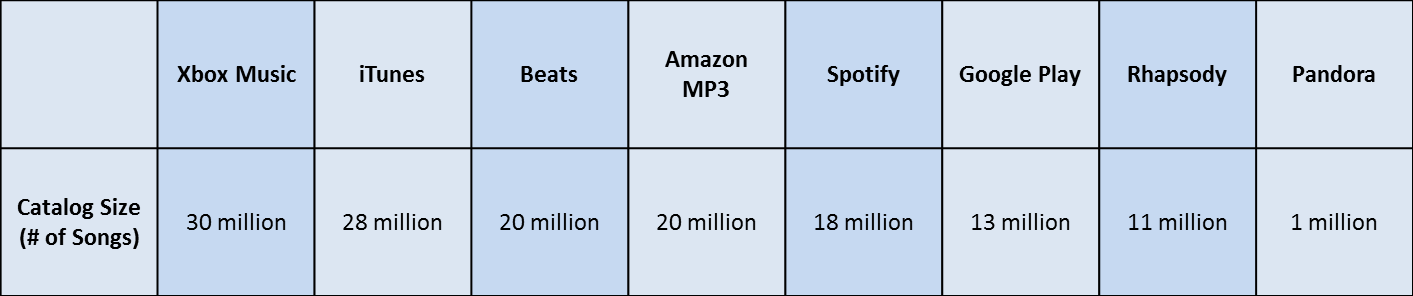
The net is, I’m willing to pay for a bigger catalog.
2. But Quality Counts:
Not all catalogs are created equal, and you wont find all the same artists on all the catalogs. The most notable example of this is the Beatles on iTunes, but there are other examples across all of the catalogs, the challenge is there really isn’t any consistent way to know what catalog contains what music. It all comes down to the deals struck with various record labels and music companies.
And in addition to quality of it’s catalog, quality curation of the “sounds like” stations is also a differentiator between music services. In the early MSN Music days these were curated by people, a more expensive but higher quality mix of music than basing mixes on computer algorithms. Sadly, as this has evolved to Xbox Music, it is clear that this has become programmatic, as picking a “sounds like Frank Sinatra’ stream will likely end up with an occasional holiday song mixed in, even if it is July.
The net is, I’m willing to pay for a higher quality catalog and higher quality dj’ing.
3. It’s All About Dat Bit Rate:
Bit Rate is to the ears what mega-pixels are to the eyes, or more correctly, pixel-density. It’s simply the fact that the more data (bits) one puts into sound or pictures, the more rich and vibrant it is to the listener, or viewer. The main point for us consumers is the more bits per second of music the better the sound but the cost is that more space is required to store it and the more bandwidth is needed to stream it over the wire or over the air.
Tying to decipher the various bit-rates offered by the various streaming services can be complex. In fact, many music services don’t specify what their bit rate is, and bit rates understandably vary for mobile over cellular vs wired/wifi streams.
The net is most free streaming services stream at or below 128 kbps, which to me is kind of like AM to maybe FM quality, while premium subscription services generally are in the 192 kbps to 320 kbps range, which is generally considered “CD Quality” range.
Note: I fully expect that when Apple (re)launches the Beats Music service they will have a “Retina Display” equivalent for sound quality, maybe “Temporal Sound” or “Auricle Audio”. We’ll see, but trust me, they won’t be pitching the concept of “bit rate” to the average consumer, they’re way smarter than that.
The net is I’m willing to pay for better sounding music.
So What is My Plan for Music?
CDs Matter to Me Again:
I’m guessing that while Apple, Tidal and others will do exclusive digital deals with artists, the higher revenue opportunity for direct CD sales means we will continue to see this music available for purchase via CD or MP3 download. And to me that means songs or albums I really, really like, will be worth me buying in CD format, and ripping (or downloading the MP3’s) to have in my permanent music collection regardless of who does what licensing deal with which music service.
I no longer see this as an either-or decision, rather a more holistic approach to my music listening.
I’ll Continue to Subscribe to a Premium Streaming Services:
While picking any one music service might mean you will forgo streaming of some exclusive content locked into another service, I still believe in the overall value of streaming, and am willing to pay for the attributes I listed above.
And I’ll augment this with direct purchases of music I want that is not in my catalog of choice via CD or digital downloads.
I’m Reconsidering Which Music Service I Subscribe To:
I’ve always been a hometown person and I wholeheartedly embrace my pro-Microsoft bias, but the world is evolving. It’s becoming much more of a “pick the best combo of devices and services” world as evidenced by the variety of cross-platform services from Microsoft, Google and Apple (well kinda). While some will blindly buy only one brand because of the logo it carries, I think most people want to have the flexibility to choose the mix of devices and services that best meets their needs.
Under Satya’s direction Microsoft is taking a much more open approach, and focusing on “reinventing productivity” and that is their core. And while they are also a hell of a gaming console provider, there is no doubt that the media and entertainment segment is Apple’s core (no pun intended). And to that end, I expect that Apple will deliver a very compelling music service when it re-launches Beats.
Compelling enough that this Microsoft die-hard may look seriously at dropping my Xbox Music subscription… unless of course Apple does something draconian like discontinuing the current Beats Music app for Windows Phone.
But then again, there’s the promise of Windows 10 and Universal Apps, but that’s for another blog post.

 clarkb...