
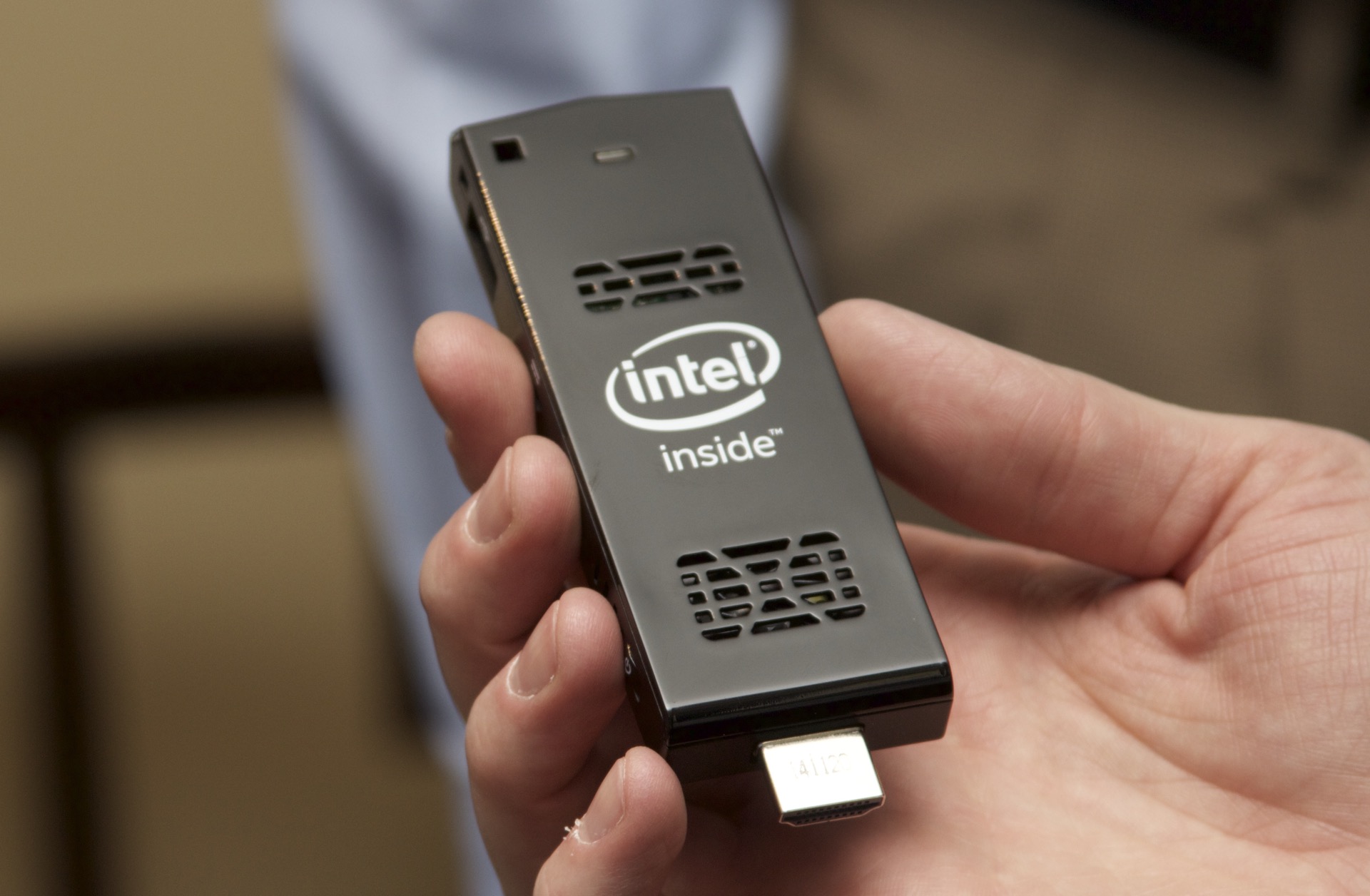
 This week Intel began taking pre-orders for their new Intel Compute Stick which is essentially a harmonica sized PC with an HDMI connector on one end that you plug into your TV and use just like you would any other Windows PC. While it’s technical specs are fairly low-end it does pack an amazing amount in it’s small, very portable size.
It runs full Windows 8, is upgradeable to the upcoming Windows 10, has Bluetooth so you can connect a keyboard and a mouse, has WiFi so you can connect to the internet, has USB and an SD slot so you can connect other devices and add more storage, and it’s only $149, ONLY $149! that’s amazing.
Amazing, yes, but it’s not clear to me that Intel will sell a bunch of these, and I’m not even sure that’s what their goal is, and therein lies the risk.
Because of it’s size and design, basically a PC “stick” device you attach to the back of your TV, people will compare it to things like the Google Chromecast, Roku Streaming Stick or Amazon Fire TV Stick and even boxes like the Roku, Apple TV or Amazon Fire TV, and that’s both wrong and dangerous. And not just for Intel, but more importantly, Microsoft.
I’ll discuss that danger below but first, just what to you get in a harmonica sized PC for $149, and why would you want one?
Budget PC Performance for a Budget Price:
Over the last few months there have been a number of budget priced PCs launched that can comfortably allow you to browse the web, stream media, play casual games, run productivity apps like Microsoft Office etc and the Intel Compute Stick will let you do just that. Similar to the Netbooks of a few years ago these all provide basic computing at a very affordable price.
From a technical perspective the Compute Stick uses the lower-end Intel Atom processor which sits below the more typical Celeron and Core processors that you find in most laptops and desktops. This, along with only having 2GB of memory, and 32GB of storage, puts the Compute stick in-line with budget notebooks like the $199 ASUS EeeBook X205TA. While you can’t add memory to the Compute Stick, you can add additional storage via an SD card.
So while you won’t be playing graphics intensive games, or doing large-scale movie or photo editing, you can certainly do most of the tasks that average PC users do on a daily basis. And with more and more of our content being stored in the cloud, the limited storage on the Compute Stick doesn’t really present an issue.
Turn a TV into a Second or Third PC:
At four inches long, a half an inch thick, and weighing less than two ounces, the Compute Stick is ultra-portable for a PC, but I don’t really see people carrying these around on a daily basis. To me the most appropriate use-case for these is turning a TV into a second, or third PC. And I don’t mean turning the big-screen TV in your family room into a PC, though you could certainly do that, I mean a smaller tv that you might have in a guest bedroom, or on the kitchen counter, or in your camper, RV, boat or vacation home, that could now easily and cheaply get double duty as a PC.
It’s also possible in a business setting a company might have one of these permanently attached to the large screen in their conference room. I could see the advantage of not having to dedicate one of the meeting attendees PC’s into the presentation machine, but most of us are used to the “let me project my screen” approach, plus it would be easy for these to walk out the door, so I don’t see this as a main-stream use.
The Risk and Danger to Microsoft:
Note that I’m not saying the risk and danger to Intel, though they certainly face some risk with the Compute Stick. The far bigger risk and danger is to Microsoft.
As I noted above, because of it’s size, shape, and attachment directly to the back of a TV, the mainstream and consumer media will make immediate comparisons to the Chromecast, Roku Stick and related media streaming devices. And this will be done both for simplicity as well as to produce attention grabbing headlines like “The Compute Stick: Microsoft and Intel battle back against Google, Apple and Amazon”.
Unfortunately, it will be completely wrong to compare a fully functional PC with single or special purpose media streaming devices like Chromecast and Roku Stick.
To be fair, as you can see in it’s marketing, Intel clearly is not positioning the Compete Stick as a competitor to those devices. In fact, it lists streaming fourth behind light productivity, social networking, and web browsing as the target use for the device. The Compute Stick is not intended to be a big screen, ten-foot user-interface box for streaming media in the family room, but these comparisons will be made.
And that’s a huge risk for Microsoft. Despite the fact the Surface Pro 3 has been very well received and has had strong sales results, you don’t need to be in the tech sector to know Windows 8 generated a huge amount of negative press for Microsoft. Add that to the on-going challenges they have had in search and the mobile space and Microsoft can ill afford more negative press. To date we’ve not seen Microsoft say much about the Compute Stick, and Intel really hasn’t either, but in that vacuum others will step in and spin the news.
So that’s Intel’s Compute Stick; intriguing, affordable, not being well marketed or positioned. Do I want one? Yes. Do I need one? Not really. Will I buy one? Probably, after all, that’s less than a pair of shoes at Nordstrom.

 clarkb...