
 With the announcement today of the new Surface 3, a follow-on to the Surface Pro 3 announced last May, I find myself in a renewed conundrum… should I buy it?
To be clear, this is a borderline want-vs-need thing but I just can’t help myself, see… I’m a deviceaholic.
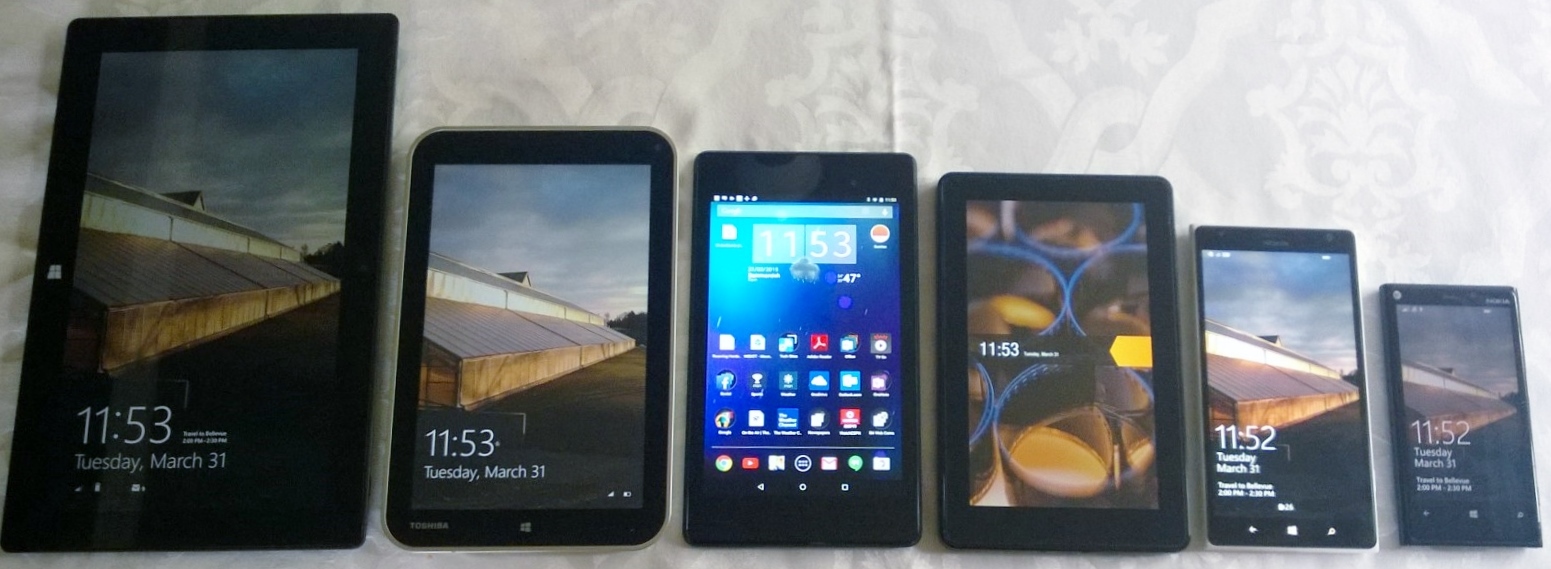
Not counting the dual screen desktop in my office, and the Sony Viao laptop permanently connected in our stereo closet as a music streaming device, I have 6 tablet/phone devices, well 7 actually, if you count my back-up Nokia Lumia 800.
Yep, that’s them in the picture, from left to right: Surface RT, Toshiba Encore 8, Nexus 7, Kindle Fire, Lumia 1520 and my Lumia 920. And that’s just me, this doesn’t include my wife’s iPad and the two Dell Venue 8 Pro’s my sons use.
Which begs two fundamental questions; Why? and Why on earth would you want or need another one? Well… it’s complicated, but I’ll try to answer:
Why? The Search for the Perfect Form Factor:
Since the start of mobile computing I’ve been fascinated with the question “what is the perfect size/form factor for a mobile device?”. Fundamentally the question is this, is there a “perfect” form factor in a device that would make it the one, and only one, mobile device you’d want to own? What’s become clear is the answer to that is three-fold:
First, and most important; it’s subjective:
We all have a different idea, and different needs, that determine what the perfect form factor is for each of us. In 2010 Steve Job’s claimed that 3.5 inches was the “perfect size” and that nobody would buy larger sized phones, but as we all know, he was wrong. Every form factor has trade-offs, advantages, disadvantages and we each make our own decision on what is “best” for us. Is it worth giving up the ability to hold and navigate a phone in one hand to have a bigger, more readable screen for browsing? Do I want a 7 inch tablet that I can easily tuck in my pocket or purse to take to the coffee shop, or do I want a 10 inch screen? It all depends on the user.
Second, “mobile” is a fuzzy thing:
It used to be mobile meant phones, so the debate was between 3″, 3.5″, 3.7″, 4″, 4.5″, then Apple introduced the iPad, and Android and Windows tablets followed, and the debate shifted to casual computing devices you used on the couch or in a chair, which of course ignited the whole phablet/at what size does a phone become a tablet or a tablet become a phone debate. And then came thin, light, touch-screen convertible tablet/laptops like the Microsoft Surface and the Sony Yoga . And by definition the lines of mobility have blurred and there really is no longer the question of which ONE mobile device I want to own, it’s a question of which ones.
Third, what we feel is “perfect” changes over time:
And it changes both based on our evolving personal needs and preferences as well as the advances in technology, which includes ever decreasing price-points. In 2005 you couldn’t really ask the question “would you like a phone with a 7″ screen?” because the thickness, cost and battery life was not at a point where it was even conceivable to ask this question. My personal preference has evolved itself and while the 4.5″ Lumia 920 felt huge when I moved from the 3.7″ Lumia 800, I now don’t give it a second thought. And despite it’s delays since first being shown in 2010, Flexible AMOLED screens, like the ones coming from Samsung , will render the whole screen-size discussion moot as we will carry devices that will have screens that can be expanded or shrunk depending on what we need at a given moment.
For me personally? I could never carry just one device, and I know most of you don’t either. I find for me ~ 4.5″ is a good size for a “phone” type device which is large enough to read/consume on, yet small enough to operate with one hand. Don’t get me wrong, I love the readability of the 5.5″ iPhone 6 Plus or the 6″ Lumia 1520, but I need to use both hands to use either one and for me personally, it’s not worth the trade off.
And for tablets for me it’s even more complicated. I’ll exclude the Surface and Sony Yoga type devices from the conversation because I think the vast majority of “laptops” in the not too distant future will be convertible keyboard/touch devices.
Yes, non-touch laptops will linger at the lowest end of the price spectrum but it’s just too convenient and useful to carry a single large-screen device that can switch between a traditional laptop or a large-screen tablet not to do it. And with the continued downward price movement of touch screens cost no longer becomes much of an issue.
So that means for me personally, 7 inches is the sweet spot for a “tablet” which for me today means the Nexus 7. I can tuck it in my coat pocket, or even pants-pocket, when I walk from the car to a coffee shop, and it fits easily in my briefcase next to my larger laptop/large-screen tablet convertible. I don’t have a case on the Nexus 7 so it’s super thin, though a little scary to carry un-protected, but it’s a great coffee-shop/couch form factor.
To be fair, if I had a Dell venue Pro 8, which is pretty close in size to the Nexus 7, instead of the noticeably larger/heavier Toshiba Encore, I probably would not have bought the Nexus. I did have an additional reason to buy the Nexus, which is I wanted to get educated on Android, but that’s another article. And as nice of a device as the Kindle Fire is I prefer to use the pure version of any OS whether it be Android, Windows or iOS.
Why on Earth Do You Want or Need Another One?
Ok, and I know this is where I start to use the justifications of an ‘oholic, but here goes:
Based on my point above about where “laptops” are heading in the future, I don’t see getting a Surface 3 as a tablet decision, it’s a laptop/big tablet decision. Which is convenient because then I can exclude 5 of the 6 devices pictured above from the conversation, and it’s no longer “why do you need a 7th device?” its “why do you need a 2nd device?”.
To help you understand my thinking let me take you back to why I have a Surface RT in the first place: I had recently left Microsoft, I no longer had the latest/greatest laptop refreshed every year or so provided by my employer, and I needed to purchase a personal “laptop”. While I had the Kindle Fire, I also wanted a larger sized tablet, which led me to the Surface RT.
Why Surface RT? simply because the Surface RT became available in October of 2012, and the Surface Pro did not ship until February 2013. I would have preferred the Surface Pro but had already lived 7 months without a laptop, needed one badly, and also because I got “I-want-to-be-first-itis”, so ordered the Surface RT.
Side note: I will always think Microsoft would have been better served to have waited the extra 3 months and just shipped the Pro, but that too is another article.
As much as I liked my Surface RT, when the Surface Pro 3 was launched last May I was in full-on device jonesing. THAT was the perfect post-PC laptop/tablet hybrid.; thin, powerful, able to run a long list of new modern apps, but still able to run all the older programs I know and love like Digital Image Pro or run the web browser add-in to view the Panasonic BL-C30A web cam I bought in 2006 that still works just fine today.
Add to that an amazing pen/stylus that with a click of the “eraser” button automatically wakes up the Surface and launches OneNote, ready for hand written note taking in an instant, it’s an awesome device. And the ability to be able to run both new and older apps is one of the key strengths of Microsoft Surface and all Windows 8x/Windows 10 devices.
One example I mentioned above is web cams. Sure, DropCam is a very cool piece of hardware, but hundreds of thousands of consumers have perfectly functional web cams they bought over the past 6, 8, 10 years. Why should they have to stop using them, buy and install new cameras like the DropCam and pay DropCams recurring monthly subscription fee when they can live stream and still-screen view on their PCs, tablets and phones?
The Surface Pro 3 delivers so much capability, but it’s a bit expensive. I mean, it’s not Apple 25%+ premium expensive, but it still was not a slam dunk for replacing a device bought only ~18 months previously.
Which brings us to todays announcement, the Surface 3 which is “Microsoft’s lightest, thinnest and cheapest tablet”. Starting at $499 (without keyboard) the full on 4GB RAM, 128GB of storage version with keyboard and pen clocks in at an affordable $780, that’s amazing.
To really put this in perspective, an unlocked iPhone 6 Plus with 128GB of storage on Amazon.com is $969… that’s $969 for a PHONE! That’s worse than $45 for a t-shirt.
So yes, I know I’m a deviceaholic, but come on, the Surface 3 is so powerful, so affordable, and I can always find another use for my Surface RT. Looks I’m going to have to take a new picture, but shhhhh, don’t tell my wife ;-).

 clarkb...