
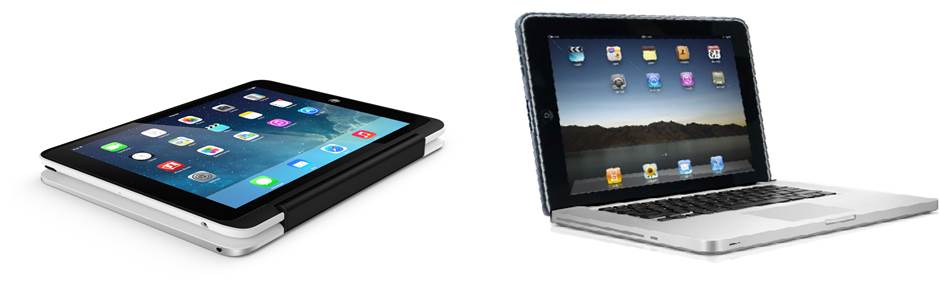
The ease of an iPad, combined with the power of a MacBook.
The keyboard of a MacBook, combined with the touchscreen of an iPad.
A single device that easily switches between consuming and creating.
The iPad Pro, it’s about time.
Ok, just kidding, nothing has been announced… yet. But is Apple working on converged devices? My bet is yes and as much as they might deny it there’s some pretty strong reasons why converged devices, and therefore converged Operating Systems, make sense.
Let’s take a look…
Let’s face it, it’s no longer it never has been a binary world:
The historical argument some manufacturers have made is “Phones and tablets are for consuming, laptops and PCs are for creating”. But the issue isn’t “Do I want to consume or create?”, the issue is I do a mixture of both, admittedly to varying degrees, across my phone, my tablet, my laptop and my desktop, and I want as good of experience as possible of both consuming and creating on whatever device I happen to be using at the moment.
Sure, in the early days of mobile devices there were more specific limitations between devices, but in the past few years the line between phone/tablet/laptop have blurred considerably. Why then should the device I use be confined to an either/or limitation?
To be clear I’m not suggesting a phone should be as equally capable of composing a business plan or manuscript as a desktop, what I’m suggesting is our use of devices is not black and white, it’s shades of grey, and the device we have at hand shouldn’t artificially limit our needs.
As consumers use smartphones and tablets more they want and expect consistency across all their devices.
Smartphone and tablet usage is overtaking PC usage and as we spend more and more time shifting between various devices one thing becomes abundantly clear to me, I want the conveniences and experiences I have on one device available on all my devices.
Take for instance predictive typing; the ability for my phone to predict the word I’m typing based on the letters I’m starting to type, and the words I typed before it helping predict the next word I want to type, is super useful and quick. Why shouldn’t I want and expect that same speed and convenience on my laptop or desktop?
Or pinning specific items like my ToDo List, Shopping List or the Seattle Times “Sports on the Air” webpage to my desktop. These are things I use pretty regularly and I want them there, one touch away, on the start screen of my phone, tablet, laptop, and desktop.
And the more those types of things become intuitive the more we stumble when something expected doesn’t occur simply because we happen to be using a different device for the same or similar task.
Come on, how many times have you started to reach up to the screen on your laptop to pinch or zoom a photo… or wish you could. Your brain goes “hey, there’s a photo, I want to get a better look at it, I’ll just swipe it out…. oops, never mind, this screen is a laptop, not a tablet”.
Wait, what? You say you have years of using a mouse and keyboard? To you it’s natural to make the switch between the two? I’ll still argue the more we flit back and forth between devices, the more we will expect and value consistency, but let’s stay with your assertion. I get it, you were raised with a mouse and keyboard, to you it is intuitive, but those younger kids? It’s been a touch based world for them since the time they could hold a phone in their grubby, slobbery hands. Whada ya mean I can’t touch and move stuff on the screen? To the next generation that’s just dumb… just watch the video here.
But we’re in the “post PC era “, you know, it’s all about mobile now.
Yes, mobile has become a critical attribute of devices. But it doesn’t mean “mobile” replaces “PC”, it means PC gets more portable and personal, or maybe more correctly, more intimate. Sure, if you’re a manufacturer who has little to no share in the “PC” world (Apple, Google) , you’ll try to convince consumers the world has changed and that the PC (laptop and desktop) is “dead”. And to their credit, they’ve done a fabulous job in phones and tablets, and they are using those beachheads to move into the laptop and desktop space. But the PC isn’t dead, it’s evolving as it always has.
Seriously, if the PC was dead, why would Apple be investing so heavily in MacBooks, iMacs and Mac Pros? Why would Google be investing so heavily in Chromebooks?
Which begs the questions, at what screen size does a phone become a tablet? 5 1/2 inches? 6 inches? 6 1/2 inches? 7 inches? And when does a tablet connected to a keyboard become a laptop?
This past summer we spent the weekend with friends and several of them had brought along their iPads for the weekend instead of toting their laptops… but they each had a keyboard/case on their iPad. And there they sat, happily switching between keyboard and touch use, while the iPad sat on the table in front of them. Reach up to touch when it made sense, fingers on the keyboard when it made sense. And Apple sees this, and the competitive 2-in-1 touch screen/laptop devices, right?
What we do know is Apple recently patented a “Surface-Like Touch Keyboard Smart Cover” so it’s clear they definitely see the lines blurring. After all, isn’t my laptop really just a tablet with a keyboard folded out in front of it for when I need to do a lot of typing? And isn’t my tablet really just a laptop screen with the keyboard removed or folded back?
Even if the majority of the blur and crossover is between phones, tablets and laptops, that still means 3 of the 4 primary computing form factors act and behave similarly. This then increases my familiarity and expectation on features and capabilities, putting even more pressure on the laptop, and potentially the desktop, to be and act more “post PC era-ish”.
And on top of this, the sales of tablets have fallen dramatically. Part of this is saturation, part of this is the fact that the primary use in “tablet mode” is light-weight consumption and entertainment. Which means these uses don’t push the limits of the existing hardware and my 3-4 year old tablet still works just fine at doing those things.
But the operating system for a phone or tablet are very different from a laptop or desktop.
Really, why? I understand power and portability force different requirements on OS’s, but with the evolution of high capacity, low power chip-sets and SOCs, the underlying hardware is getting pretty blurry as well. Technically there’s less and less technical reason for a different OS between tablets and laptops, and even desktops.
Well, then the User Interface clearly has to be different between tablets and laptops, right? There’s no doubt it has been, and it’s quite possible there always will be, but based on the points above, the line seems to be moving from phones and tablets having one UI and OS, to phones, tablets and laptops sharing a common UI and underlying OS components.
And not just from a UI perspective, but from an Apps perspective there’s a huge issue here. If, because of a common underlying OS structure, developers can easily develop a common app and target phone, tablet and laptop, the market for that app suddenly becomes significantly larger, and the cost to the developer drops in reaching all three of those platforms. (Caveat: I’m not a platform/dev expert so I won’t pretend to be able to argue all the platform architecture issues, but there are lot’s of super smart people working to deliver this kind of environment for developers.)
And in a world where it’s easy to target phones, tablets and laptops with a common app there will be growing pressure to have that same app run in a desktop environment as well. And then the world get’s really, really interesting.
And suddenly the whole common OS issue becomes huge.
Microsoft deserves some heat over Windows 8, but they’ve ripped off the Band-Aid and time will tell if it was too abrupt or not.
With Windows 8 Microsoft made the bet and the investment that converged OS and UI were inevitable across phones, tablets, laptops and even desktops. With Windows Phone 8 Microsoft now uses the same kernel as Windows 8, and Windows tablets, laptops and desktops all use the same OS (with the exception of Windows RT which may arguably be headed for obsolescence).
Was this done without a fair amount of pain and frustration for some users? no. As they did with Zune and Windows Phone 7, Microsoft focused on trying to beat Apple head-to-head on iPod and iPhone, instead of leveraging it’s strength in productivity and Windows to evolve their user base in a more gentle set of phases. That being said I for one feel the issues have been overly inflated, and with the pending release of Windows 9, they seem to be getting this sorted into a more digestible balance.
Side note: I find it interesting that the same people that complain about switching between the Modern and Desktop UIs of Windows 8 seem somehow perfectly able to deal with three totally different environments between their Samsung Galaxy phone, their iPad and their Windows Laptop. Maybe at some point if all three devices get too close together people’s heads explode but I just don’t see the issue.
So what’s the end-game?
To date, Apple and Google have drawn the OS/UI line with phones and tablets on one side (iOS/Android), and laptops and desktops on the other (Mac OS/Chrome), but is this the right place to draw the line, and over time does a line really need to be drawn at all?
With Apples investment in better keyboards for the iPad, and manufacturers making Android based convertible/2-in-1 laptop/tablet hybrid devices, the trend to commonality across phone, tablet and “laptop” is increasing.
When you start using your iPad more like a laptop, will you also start wanting your MacBook Air to start being able to act more like your iPad? Will you want to occasionally be able to touch that screen, or flip it back and use it like your used to using your iPad?
And by this I’m not trying to infer it’s an either/or world. It’s not “do I buy a laptop or do I buy a tablet?” It’s an issue of if I happen to have my tablet in my hand, and want to do some extended typing, flipping out a keyboard would be really nice, but also give me the capabilities I expect in a laptop. And if I happen to have my laptop, and want to do some more browsing/consumption types things, wouldn’t it be nice to just flip the keyboard back instead of running and finding my tablet? Oh, and give me a touch base UI because I’m now in tablet mode.
Sept 2014 Update:
I personally think people will continue to have both “tablets” and “laptops”, but imo pure tablets will tend towards smaller screen sizes of 8-10 inches, while the 10″+ inch tablets will be replaced by 2-in-1 convertibles as noted in this recent article in Forbes: Surface Pro 3: The Laptop That Can Replace Your Tablet.
So is the future a converged OS world? I think the answer will increasingly be “yes” which has huge ramifications for Apple, Google and Microsoft in how you enable this and what you do from both an OS platform perspective and as well as a hardware perspective.
Will Apple make this move in one fell swoop? No, they will begin to evolve their devices and OS’s and gradually move their users along a continuum to convergence, and I believe there’s a high likelihood they’re already working on it.

 clarkb...
1 Comment